
Philip Connaughton is one of the most compelling voices in contemporary dance to emerge from Dublin in recent years. A choreographer with a rigorous technical foundation and a fiercely personal artistic vision, Connaughton has built a body of work that moves fluidly between dance, theatre, visual art, music, and text. His creations are often immersive, emotionally charged, and intellectually sharp, inviting audiences not simply to watch, but to enter the world of the performance and experience it from within.
Trained first in Dublin before continuing his studies at the Rambert School of Ballet and Contemporary Dance in London, Philip’s career has been shaped by a strong physical language and an enduring curiosity for experimentation. That technical grounding quickly evolved into a distinctive choreographic practice, leading to a 2012 residency at axis:Ballymun, where he created Mortuus Est Philippus for the Dublin Dance Festival and Festival Instances in Chalon-sur-Saône. By 2013 he had become an associate artist of Dance Ireland, and in 2014 he founded Company Philip Connaughton. His first large-scale ensemble work, Tardigrade, went on to win Best Design at the Tiger Dublin Fringe Awards, announcing him as an artist capable of merging strong conceptual thinking with striking stagecraft.

From the beginning, Connaughton’s work has resisted categorisation. His choreographic language sits at the intersection of movement, theatricality, and visual composition, often punctuated by humour and text that deliberately break the fourth wall. This ability to make complex or difficult themes accessible without ever diluting their intensity is one of the defining features of his practice. Whether through the lecture-performance Dance Uncovered (sensational) or the extensively toured Whack!!, created with Ashley Chen and CompagnieKashyl, Philip has consistently shown a desire to challenge form while keeping the audience emotionally and intellectually engaged.
At the heart of his artistic vision lies a deep commitment to collaboration and experimentation across different artistic languages. For Philip, choreography is never isolated from the worlds of sound, image, language, or design. Instead, performance becomes a meeting point where multiple disciplines strengthen one another. This collaborative ethos is central to his practice and is especially visible in Trojans, where movement is not simply accompanied but powerfully amplified by the visual and sonic worlds surrounding it.
Trojans: At the Centre of Philip Connaughton’s Vision
Now more than ever, Trojans stands as one of Philip Connaughton’s most urgent and defining works.
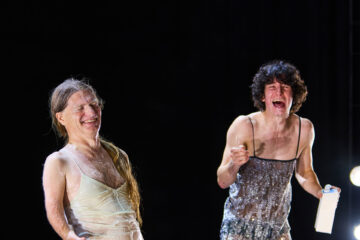
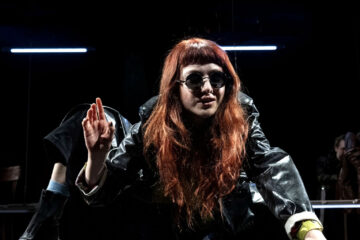
Luail: Ireland’s National Dance Company proudly revives Trojans, the groundbreaking dance production originally created by Company Philip Connaughton & Once Off Productions. Inspired by Virgil’s The Aeneid, the work fuses Connaughton’s physically charged choreography with an electrifying original electronic score by Oberman Knocks and haunting, atmospheric visuals by Luca Truffarelli. The result is a work of extraordinary force: immersive, contemporary, and emotionally raw.
Its return is particularly significant because the show began its new run on 26 March at Project Arts Centre in Dublin, reaffirming its place as one of the most resonant and necessary works in Irish contemporary performance right now. TICKETS HERE
Trojans revisits themes that remain as pressing today as they were in antiquity: war, migration, displacement, fate, exile, identity, and survival. In Connaughton’s hands, Virgil’s epic is not treated as a distant literary monument, but as living material: painfully current, politically charged, and deeply human. He strongly believes that the classics withstand the test of time precisely because they continue to speak to the present, and Trojans is a vivid demonstration of that belief. His interpretation feels refreshing because, while unmistakably modern and personal, it remains faithful to the original spirit of Virgil’s text.
Importantly, Philip’s Trojans is not a decorative retelling of the classical source. It is a bold, stripped-back reimagining. Connaughton has deliberately removed the romantic dimension of the relationship between Aeneas and Dido, shifting the focus away from sentiment and toward something harsher, more inevitable, and more existential: destiny, fate, rupture, and the brutal mechanics of history. In doing so, he returns the material to something more raw and harsh, exposing the violence and instability at the core of the story.
That choice gives the work much of its power. Rather than romantic tragedy, Trojans becomes a meditation on what it means to be uprooted: to lose one’s place, one’s certainty, one’s inherited world. It is precisely through this lens that the work speaks so directly to contemporary audiences. The themes of migration and displacementare not treated as abstract ideas, but as embodied realities carried through the dancers’ physical presence, tension, momentum, and collapse.
There is also a striking biographical echo within this production. Philip began his own stage career at La Scala in Milan, where he performed in Les Troyens. While his current choreographic version of Virgil’s poem is clearly very different, deeply personal, and unmistakably his own, that early encounter with the Trojan myth adds a compelling layer to the work. What once existed as a grand operatic experience has here been transformed into something visceral, contemporary, and stripped to its emotional and political core.
You can also listen to the Radio Irlanda interview at Philip Connaughton HERE

An Immersive Experience: Dance as an Energy Journey
One of the most powerful aspects of Trojans is the way Philip conceives performance as an immersive experience. His intention is not merely to present movement, but to take the audience on an energy journey.
This is crucial to understanding the piece. The spectators are not positioned as passive observers kept safely at a distance. Instead, the audience experiences the work from all four sides, becoming physically surrounded by the action and fully absorbed into its atmosphere. This spatial arrangement intensifies the performance and creates a heightened sense of participation, proximity, and emotional exposure. The audience is invited to receive, absorb, and almost physically share the energy of the work.
That energy is reinforced by the extraordinary collaboration at the heart of the production. The expressive power of the dance is deepened and expanded by Luca Truffarelli’s visuals, which shape the emotional and aesthetic landscape of the piece, and by the original electronic soundscape of Oberman Knocks, whose score gives Trojans its pulse, urgency, and propulsion. Together, choreography, sound, and image create a multisensory environment that feels both intimate and epic.
Personal and Political: The Breadth of His Work
Although Trojans currently stands at the centre of his artistic output, Philip Connaughton’s wider body of work reveals a choreographer deeply invested in both personal intimacy and social inquiry.
A recurring thread in his practice is the exploration of isolation, vulnerability, and the attempt to reconnect with lost or fractured parts of human experience. This is especially evident in Assisted Solo, created for the 2018 Dublin Fringe Festival, and in Mamafesta Memorialising. Developed at KLAP in Marseille before runs at Cork Opera House and Project Arts Centre in 2019, the latter work drew on Philip’s intimate relationship with his mother during her experience of dementia. These works demonstrated his ability to transform deeply personal material into performances of wider emotional and cultural resonance.
At the same time, his focus often extends beyond autobiography into broader civic and political concerns. Through the project Yes, but do You Care?, created with artist Marie Brett, Philip explored the impact of Irish legislation on carers, once again using performance as a means of opening difficult social conversations. This willingness to move between the intimate and the structural, the private and the public, is one of the reasons his work continues to feel so vital.
Philip’s collaborative spirit has also led him into major interdisciplinary and theatrical projects. In 2022 he worked with Phillip McMahon and THISISPOPBABY on Party Scene for the Cork Midsummer Festival and the Edinburgh Festival, as well as No Control for the Carlow Arts Festival. That same year he also performed in WAKE at the Dublin Fringe Festival, before ending the year with Love Songs. He also received an Irish Times Theatre Award for his contribution to Much Ado About Nothing with Rough Magic, confirming the range and impact of his choreographic voice beyond the dance world alone.

Recent Work and Ongoing Momentum
Philip’s recent projects continue to challenge ideas of identity, resilience, memory, and presence. Following the 2023 production of Trojans for the Cork Midsummer Festival, 2024 saw him bring the work to Dublin while also touring Party Scene across Ireland and Germany. He recently choreographed Carousell for the Princess Theatre Melbourne and Emma at the Abbey Theatre, further demonstrating his ability to move between contemporary dance, theatre, and large-scale stage production.
He is also currently working on a short dance film titled Rebellious Hope with Luca Truffarelli and Mel Mercier. Focused on older dancers and their refusal to disappear, the project continues his ongoing interest in visibility, embodiment, and resistance.
Philip Connaughton is currently a Project Arts Centre resident artist and a THISISPOPBABY company artist, two roles that reflect both his artistic stature and his continuing relevance within Ireland’s contemporary performance landscape.
Pinocchio Magazine Comments
Philip Connaughton’s work matters because it refuses easy categorisation and easy comfort. He is an artist who understands that dance can be intellectually rigorous without losing emotional immediacy, and politically resonant without becoming didactic. His choreography speaks through bodies, but also through space, rhythm, image, memory, and disruption.
What makes Trojans especially powerful is its refusal to romanticise collapse. Instead, it confronts the audience with instability, rupture, movement, and survival. It is a work that understands the ancient world not as something finished, but as something that continues to echo through the urgencies of the present.
Connaughton’s version of Virgil is compelling precisely because it does not seek to preserve the classical text behind glass. It activates it. It makes it vibrate again. And in doing so, it reminds us that the strongest contemporary art does not abandon the past: it re-enters it, wrestles with it, and returns it to us changed.
In Philip Connaughton’s hands, dance becomes more than choreography. It becomes encounter, tension, and transmission. Above all, it becomes an energy journey: immersive, unsettling, and impossible to watch from a distance.
Read also: Luca Truffarelli – The Weight of not helping enough
Find out more stories HERE