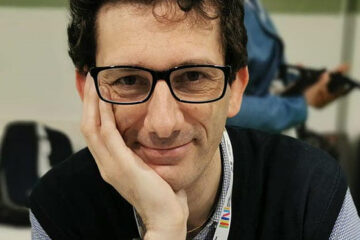

Pier Paolo Giannubilo is a writer who lives at the intersection of education and narrative invention. Born in 1971 in San Severo in southern Italy, he grew up between Puglia and Molise and later settled in Campobasso, where he teaches Italian and Latin literature at a high school while building a literary career rooted in both personal history and broader cultural questions.
Giannubilo’s path into writing was neither planned nor linear. After finishing classical studies, he moved to Perugia to study modern and contemporary Italian literature, eventually returning to Molise. Before becoming a teacher, Giannubilo worked as a bookseller, received a grant from the Ministry of Cultural Heritage, worked as a journalist covering politics, arts and music, and served as press officer to a regional president. These professional and institutional experiences form a coherent background that informs his narrative voice, combining cultural research with direct knowledge of public life.
Giannubilo’s work resists simple categorization because it draws from history, biography and imaginative reconstruction. He first came to wider attention with “Corpi estranei” (Foreign Bodies), published in 2008, a book that blends documented fact and narrative form in reconstructing the life of a child surviving brutal conditions in the 1930s. Subsequent works include Lo sguardo impuro (The Impure Gaze) and the more recent “Incendio sul mare” (Fire on the Sea), each displaying his interest in how ordinary lives endure against the backdrop of larger social forces.

But it was “Il risolutore” (The Problem Solver) that marked a turning point in how his writing is perceived nationally. Released by Rizzoli in 2019, the novel was selected among the twelve finalists for the prestigious Premio Strega, Italy’s most influential literary prize. The book originated from Giannubilo’s encounter with a man who claimed to carry extraordinary life experiences. Through listening and reworking those accounts, Giannubilo transformed memory into narrative, reflecting on identity, secrecy and the mechanics of storytelling itself.
Giannubilo has described the work behind “Il risolutore” (The Problem Solver) as a long linguistic process, aimed at balancing biography and poetic narration. In interviews, Giannubilo has noted the challenge of shaping language capable of moving across different registers, from episodes that recall spy fiction to passages grounded in intimate and concrete experience. That tension is visible in the novel’s structure and in its refusal to remain confined to a single genre.
At the core of Giannubilo’s writing is a constant dialogue between the real and the invented. He often begins with documentary fragments, or al testimonies and personal memories, then reshapes them into narrative frames that feel both immediate and quietly unsettling. This approach places Giannubilo among contemporary Italian writers who explore the boundary between reportage and fiction without dissolving the integrity of either form.

Giannubilo’s dual role as teacher and writer provides a distinct perspective. In the classroom, Giannubilo works with classical texts and ancient languages. Outside it, he applies that structural discipline to modern narratives marked by human complexity. Teaching and writing feed each other. In preparing lessons, Giannubilo refines themes that reappear in fiction, and in composing novels, he returns to the precision of language and rhythm that defines dailyacademic practice.
Despite working far from Italy’s major publishing centers, Giannubilo has carved out a place in the national literary landscape. His books have appeared in anthologies beyond regional borders, including bilingual projects presenting Italian writers to a wider audience. Participation in literary festivals and public debates confirms the relevance of a body of work that developed outside dominant cultural circuits.
Pier Paolo Giannubilo writes without spectacle. His narratives remain anchored in lived reality while seeking a language capable of carrying both memory and invention. In a literary climate often driven by novelty, Giannubilo’s steady voice highlights the enduring strength of stories shaped by attentive listening and disciplined craft.
Pier Paolo Giannubilo offers narratives that feel like conversations with history itself. His work does not raise its voice but guides readers into the quiet spaces where private lives intersect with collective memory.
Find out more writers HERE